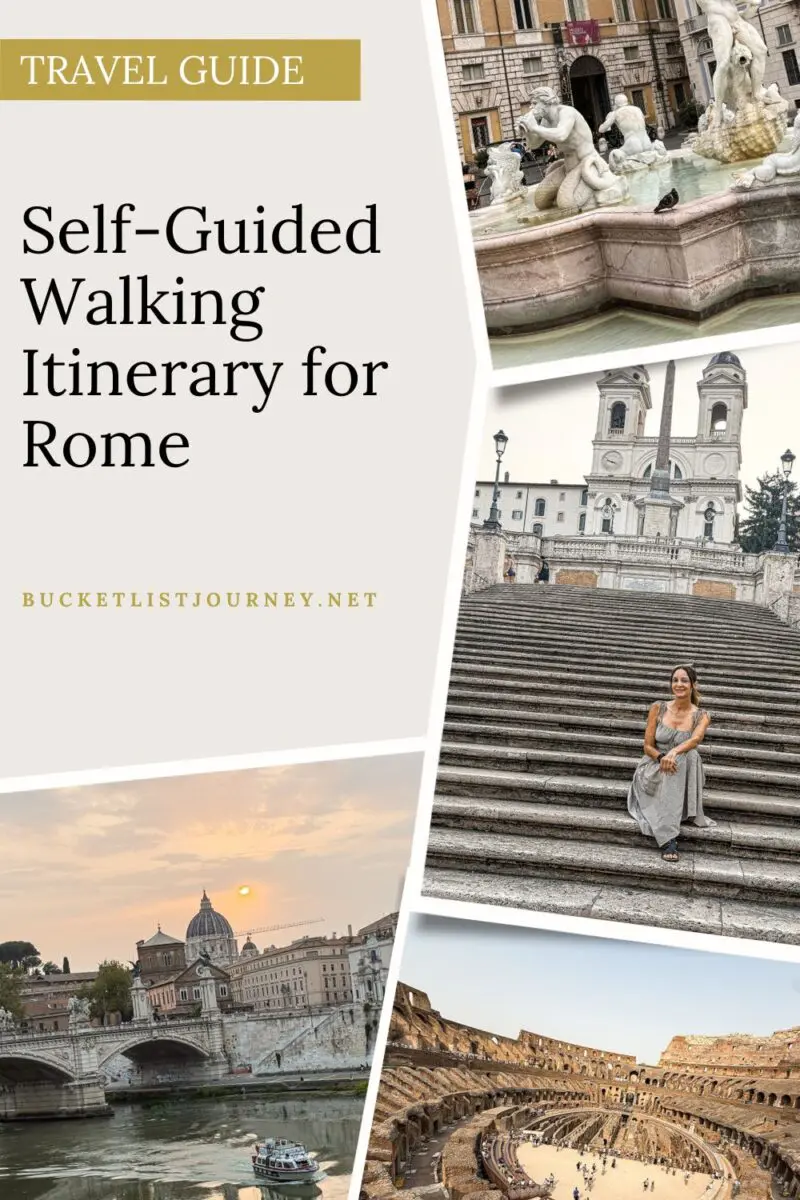
Worried you’ll spend more time figuring out how to get around Rome than actually enjoying it? My self-guided walking itinerary takes you on a logical route from the Colosseum to St. Peter’s Square, with the major sights, directions, and practical details laid out for you.
Along the way, you’ll walk through Ancient Rome, the historic center, and some of the city’s most famous piazzas and monuments without constantly stopping to figure out where to go next. I’ll show you each stop, how to get to the next one, and what’s actually worth your time.
Plan on this being a full day, especially if you go inside the major attractions. You can move quickly through the shorter stops or linger wherever something catches your eye.
After many trips to Rome, I’ve learned you simply can’t see everything in a short visit. On my most recent trip, we had just 36 hours and August was brutally hot, so we had to pick and choose what mattered most. You don’t have to check every box to have a great day in Rome.
Short on time? Here’s a quick peek at the itinerary and some planning tips for Rome:
Walking Route Stops
- Colosseum (book in advance!)
- Roman Forum (& Palatine Hill)
- Piazza Venezia
- Trevi Fountain
- Spanish Steps
- Pantheon
- Piazza Navona
- Castel Sant’Angelo
- St. Peter’s Square
Where I Stayed & Recommend
- NH Collection Roma Palazzo Cinquecento, best for an upscale stay with easy access to Termini Station; this is where I stayed
- Camplus Hotel Roma Centro ($$), a more budget-friendly option near Termini Station, I’ve stayed here too!
- Albergo delle Regioni ($$), best for a budget-friendly stay in the heart of Rome near the Trevi Fountain
- Hotel Diocleziano ($$), another comfortable choice near Termini Station
- Passepartout ($$), best for travelers who want to stay in a more central, historic area
- Hotel Nazionale ($$$), best for a classic Roman hotel in a central location near the Pantheon.
- Navona Style ($$$), best for staying in a stylish, central location near Piazza Navona
Other Things to Do
- The Ultimate Trastevere Food Tour with a Local
- Colosseum, Roman Forum & Palatine Hill Guided Tour
- Rome Underground: Catacombs Tour, Aqueducts and Appian Way
- Explore Rome on a Guided Golf Cart Tour
- Assisi and Orvieto Day Trip
- Orvieto and Civita di Bagnoregio Day Tour from Rome
Helpful Guides to Plan Your Trip
Planning a trip to Rome? Start with my One Day Rome Itinerary (Best for First Timers), and don’t miss my guide to Italian electricity and adapters or my Italian food bucket list to make sure you eat every delicious thing!
What to Know Before Starting Your Walking Tour of Rome
This is a full-day walking itinerary, and the distance adds up quickly once you include wandering around each attraction. The individual stretches between sights are generally manageable, but the combination of sightseeing, standing, stairs, uneven surfaces, and summer heat can make the day more tiring than the mileage suggests. Here are some other things to know:
- Rome also has plenty of cobblestone and uneven surfaces, so comfortable shoes are not optional in my book.
- If you’re visiting in summer, start as early as you can. I was in Rome during an especially hot August, and the difference between walking early and walking during the hottest part of the day was significant.
- Advance reservations matter for the major attractions. The Colosseum requires a reserved entry time, and the Pantheon also has timed admission (if you plan on going inside). I bought tickets through GetYourGuide before even arriving in Rome.
- And remember that you can always shorten this walk. If you’ve had enough after the Pantheon, take a taxi or public transportation rather than turning your vacation into a step-count competition.
Self-Guided Walking Tour Map of Rome
I’ve mapped out the route for you so you can see exactly where you’ll be walking and how the stops fit together.
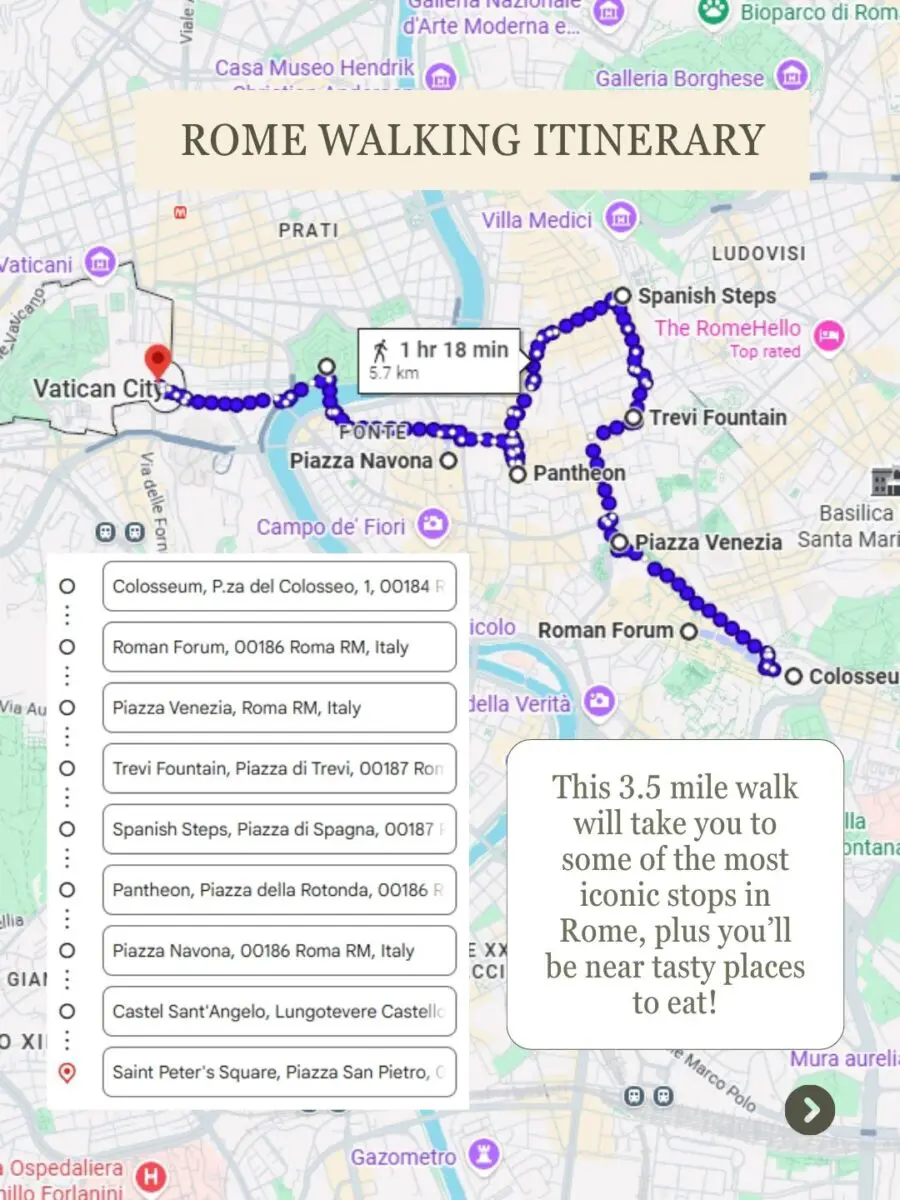
Walking Distance: 3.5 miles, does not include steps taken at sites.
Self-Guided Walking Itinerary for Rome
Stop #1: Colosseum
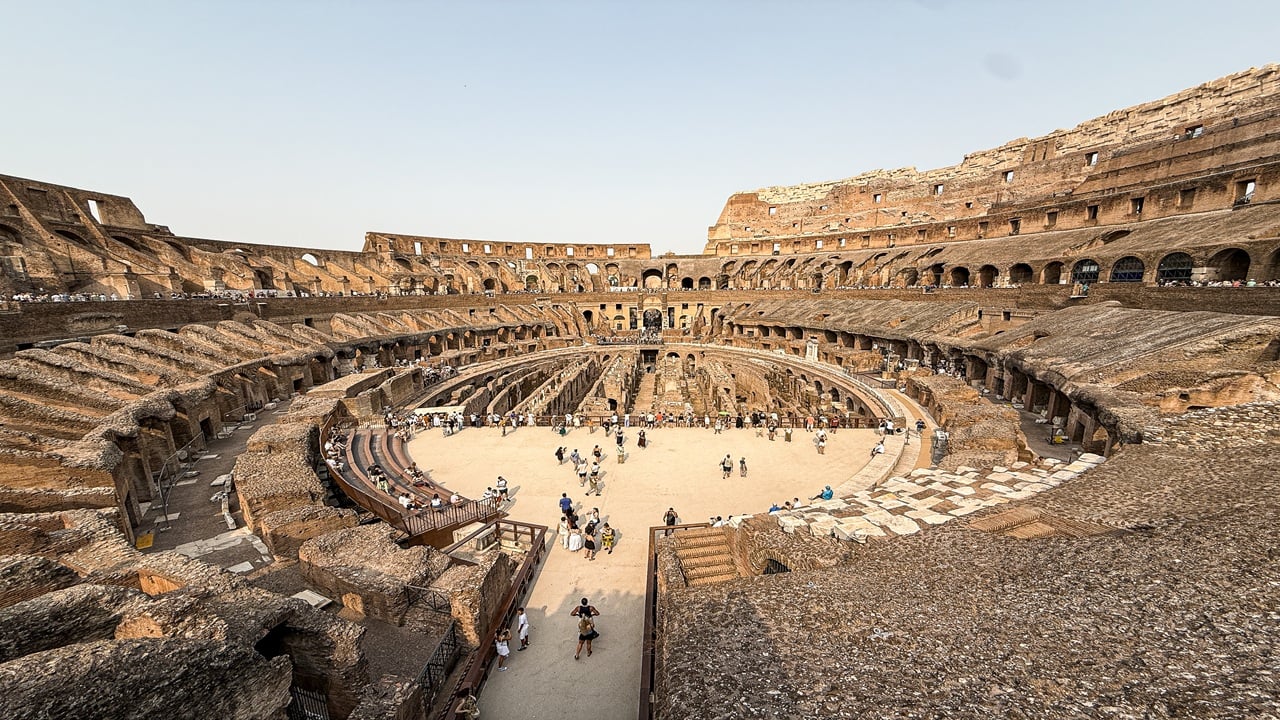
Starting at the Colosseum makes perfect sense for a first visit to Rome. It’s one of those places that is so recognizable that seeing it in person can feel almost surreal (I felt that way about the Taj Mahal too!). Construction began under Emperor Vespasian around A.D. 70 and was completed under his son Titus around A.D. 80. The enormous amphitheater hosted gladiatorial contests, animal hunts and other public spectacles, and it remains one of the defining symbols of ancient Rome. Even if you’ve seen a thousand photographs of it, standing underneath those enormous arches feels different.
I recommend going early, particularly if you’re visiting in summer. I also suggest pre-purchasing your tickets. This is one attraction where I would not gamble on finding a convenient last-minute ticket. I bought mine through GetYourGuide.
What to Know
- Time to Allow: About 1 hour inside, longer with a guided tour
- Admission: Paid (ticket includes Roman Forum & Palatine Hill)
- Reservations: Yes. Colosseum entry requires a reserved time slot (check ticket options here)
- Hours: Hours vary seasonally. From late March through September 2026, the Colosseum opens at 8:30 a.m.
Continue to Stop #2: From the Colosseum, continue directly into the Roman Forum. They’re part of the same archaeological complex, so this isn’t a separate city-center walk.
Walking Time: Essentially continuous with the Colosseum
Distance: Very short


Stop #2: Roman Forum (& Palatine Hill)
The Roman Forum and Palatine Hill are included with most Colosseum archaeological tickets. The Roman Forum was the center of public life in ancient Rome for more than a thousand years. This was where political, religious, commercial and administrative life played out, and today you can walk among the remains of temples, basilicas, arches and government buildings.
On my most recent visit, Rome was experiencing a brutal 101°F day, so I took a quick look around the Forum after the Colosseum rather than spending hours wandering the exposed ruins. I also skipped Palatine Hill entirely.
And honestly, I was fine with that. You don’t have to explore every corner of Ancient Rome to have a great day in Rome. If you have more time, by all means explore Palatine Hill and spend longer wandering the Forum. But if you’re following this itinerary in one day, this is a place where you can make your own judgment based on the weather, your energy and how much time you want to spend at the other stops.
What to Know
- Time to Allow: 30 minutes to 1.5+ hours
- Admission: Included with most Colosseum archaeological tickets
- Reservations: Colosseum entry requires a timed reservation
- Hours: The Roman Forum-Palatine area opens later than the Colosseum
Continue to Stop #3: Exit the archaeological area toward Via dei Fori Imperiali and continue toward Piazza Venezia.
Walking Time: About 10–15 minutes
Distance: About 0.6 mile / 1 km
Stop #3: Piazza Venezia
You’ll know you’ve arrived at Piazza Venezia when you see the enormous white Vittoriano dominating the landscape. Also known as the Altar of the Fatherland, the monument was built to commemorate Vittorio Emanuele II, the first king of unified Italy. Construction began in 1885 and the monument was completed in 1911.
The square itself sits between Via del Corso and Via dei Fori Imperiali and has long been one of Rome’s major crossroads. Piazza Venezia also has a more complicated 20th-century history. Palazzo Venezia, the building that gives the piazza its name, was once a 15th-century palace and later became the headquarters of Mussolini, who famously addressed crowds from its balcony.
This is more of a see-it-as-you-pass stop than somewhere I’d tell you to spend an hour. The Vittoriano is enormous and photogenic.
What to Know
- Time to Allow: 10–20 minutes
- Admission: Free to view the square and exterior
- Reservations: Not needed for the square
Continue to Stop #4: From Piazza Venezia, head toward the Trevi Fountain through the historic center.
Walking Time: About 15 minutes
Distance: About 0.8 mile / 1.3 km
Stop #4: Trevi Fountain
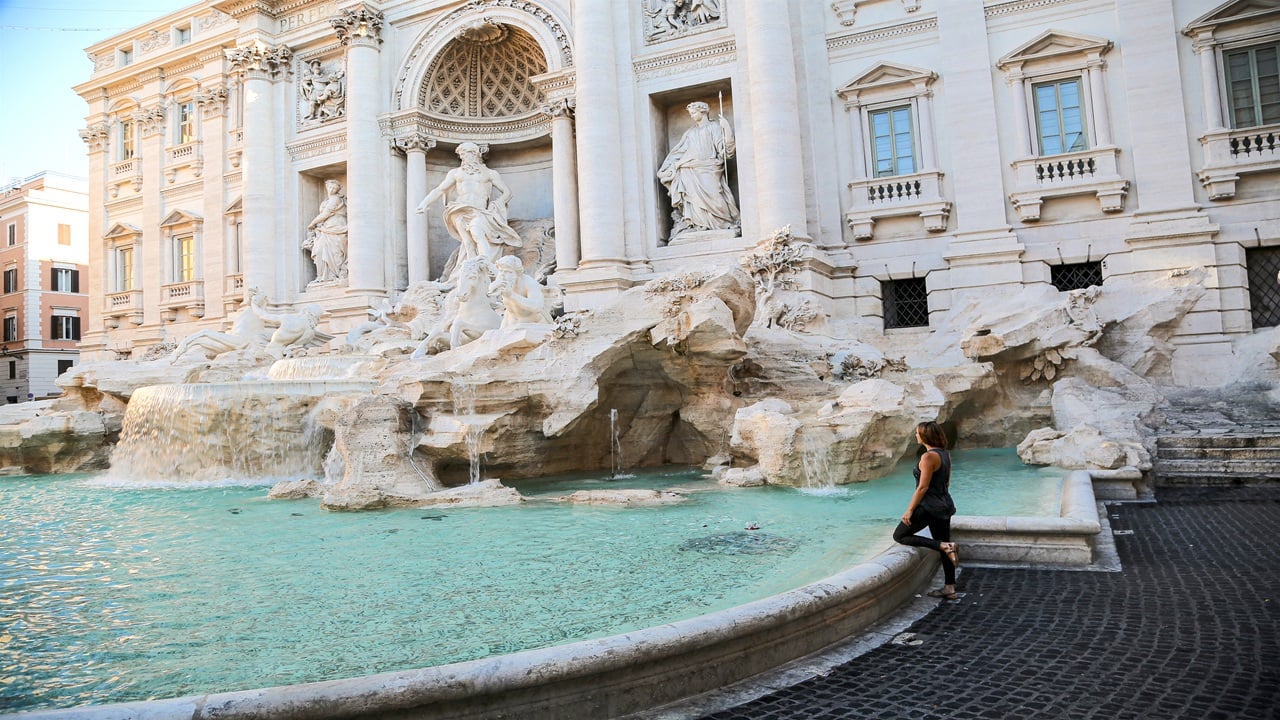
The Trevi Fountain is one of those Rome sights that actually lives up to the hype. The Baroque fountain was designed by Nicola Salvi and completed by Giuseppe Pannini between 1732 and 1762. At the center is Oceanus riding a shell-shaped chariot pulled by horses. And yes, this is where you toss the coin.
*My biggest tip is that if jet lag has you wide awake, take advantage of it and move this stop before the Colosseum. I’m always amazed by how quiet some of Rome’s most famous sights could be before 8 a.m. With that said, if you are following this itinerary, don’t skip it just because of the crowds—it will be a big regret.
What to Know
- Time to Allow: About 30 minutes
- Admission: Free to view from the surrounding area; after 9:00 AM it is €2 for non-residents to enter the closest area around the fountain
- Reservations: None
- My biggest tip: if jet lag has you wide awake, take advantage of it and move this stop before the Colosseum. I’m always amazed by how quiet some of Rome’s most famous sights could be before 8 a.m. With that said, if you are following this itinerary, don’t skip it just because of the crowds—it will be a big regret.
Continue to Stop #5: From Trevi, walk toward the Spanish Steps.
Walking Time: About 8–10 minutes
Distance: About 0.4 mile / 0.7 km


Stop #5: Spanish Steps
The Spanish Steps connect Piazza di Spagna with the Church of Trinità dei Monti above. Built between 1723 and 1726, the staircase was designed by Francesco De Sanctis and consists of 11 ramps with 12 steps in each section. At the bottom is the Barcaccia Fountain, designed by Pietro Bernini.
The Spanish Steps are less about checking off a monument and more about experiencing one of Rome’s famous gathering places. Climb the stairs, look back over Piazza di Spagna, take your photos and enjoy the architecture before continuing on.
What to Know
- Time to Allow: About 30 minutes
- Admission: Free
- Reservations: No
Continue to Stop #6: From the Spanish Steps, continue through the historic center toward the Pantheon.
Walking Time: About 14 minutes
Distance: About 0.7 mile / 1.2 km


Stop #6: Pantheon
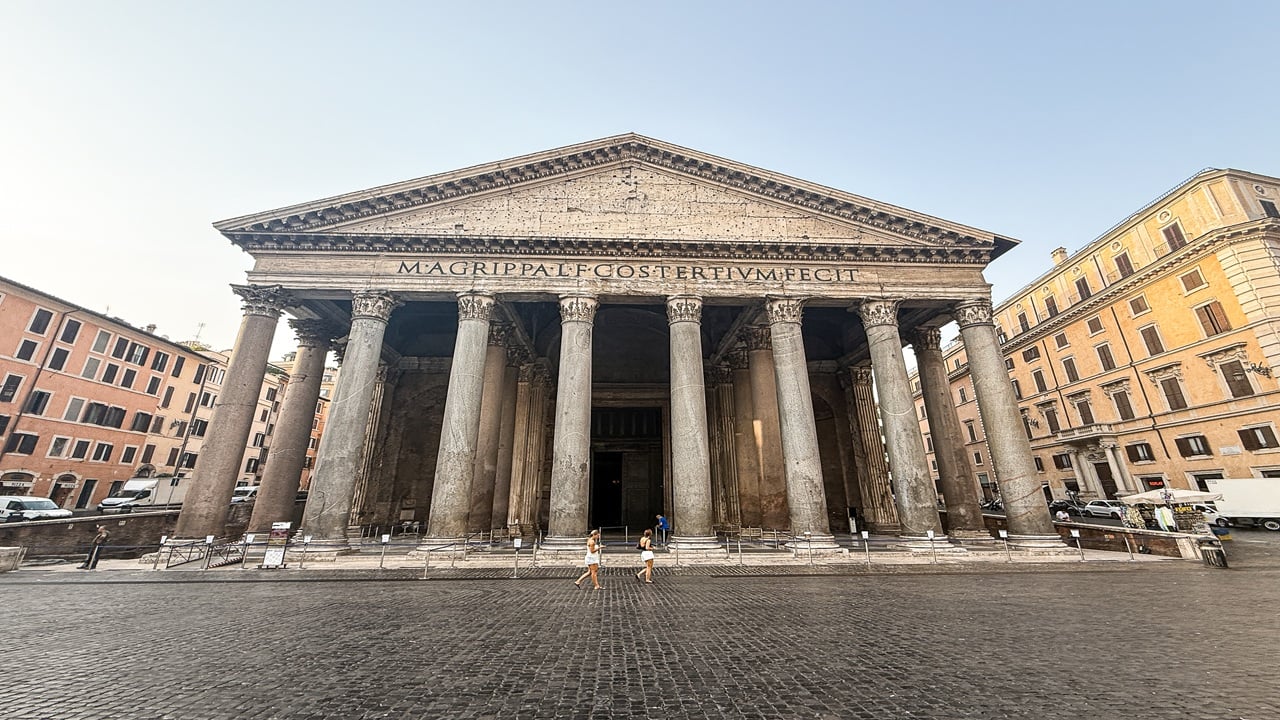
The Pantheon is one of those Rome attractions where you really should go inside. The exterior is impressive, with its enormous Corinthian columns and inscription honoring Marcus Agrippa, but the real wow moment comes when you walk through the entrance and look up at the massive dome.
The present building dates primarily to the reign of Emperor Hadrian, around A.D. 118–125, although the original temple on the site was commissioned by Marcus Agrippa in 27 B.C. The dome is particularly remarkable, with a central oculus nearly 9 meters across that serves as the building’s only source of natural light. The Pantheon was later converted into a Christian basilica, which helped preserve the building, and it contains the tombs of several notable figures, including Raphael and Italian kings Vittorio Emanuele II and Umberto I.
Don’t make the mistake of treating this as another exterior photo opportunity. The inside is the reason to come.
What to Know
- Time to Allow: About 45 minutes
- Reservations: Tickets recommend (check pricing here)
- Hours: Currently generally 9 a.m.–7 p.m., with last entry before closing; religious services can affect access
Continue to Stop #7: From the Pantheon, walk to Piazza Navona.
Walking Time: About 5–10 minutes
Distance: About 0.4 mile / 0.6–0.8 km
Stop #7: Piazza Navona
Piazza Navona is one of my favorite piazzas in Rome, and it was actually the stop that surprised me most on my latest visit because I hadn’t been before. The long, elegant square was built over the site of the ancient Stadium of Domitian and is surrounded by Baroque architecture, restaurants and fountains.
The star of the show is Bernini’s Fountain of the Four Rivers. The enormous fountain features four monumental figures representing the Danube, Ganges, Nile and Rio de la Plata, with an ancient obelisk rising from the center. There are also two smaller fountains at either end of the piazza.
But honestly, you don’t need to memorize all of that to enjoy it. Walk the length of the square, look at the fountains, admire the architecture and watch the people around you.
What to Know
- Time to Allow: 20–30 minutes
- Admission: Free
- Reservations: No
Continue to Stop #8: Walk west toward the Tiber and Castel Sant’Angelo.
Walking Time: About 12–15 minutes
Distance: About 0.7 mile / 1.1 km


Stop #8: Castel Sant’Angelo
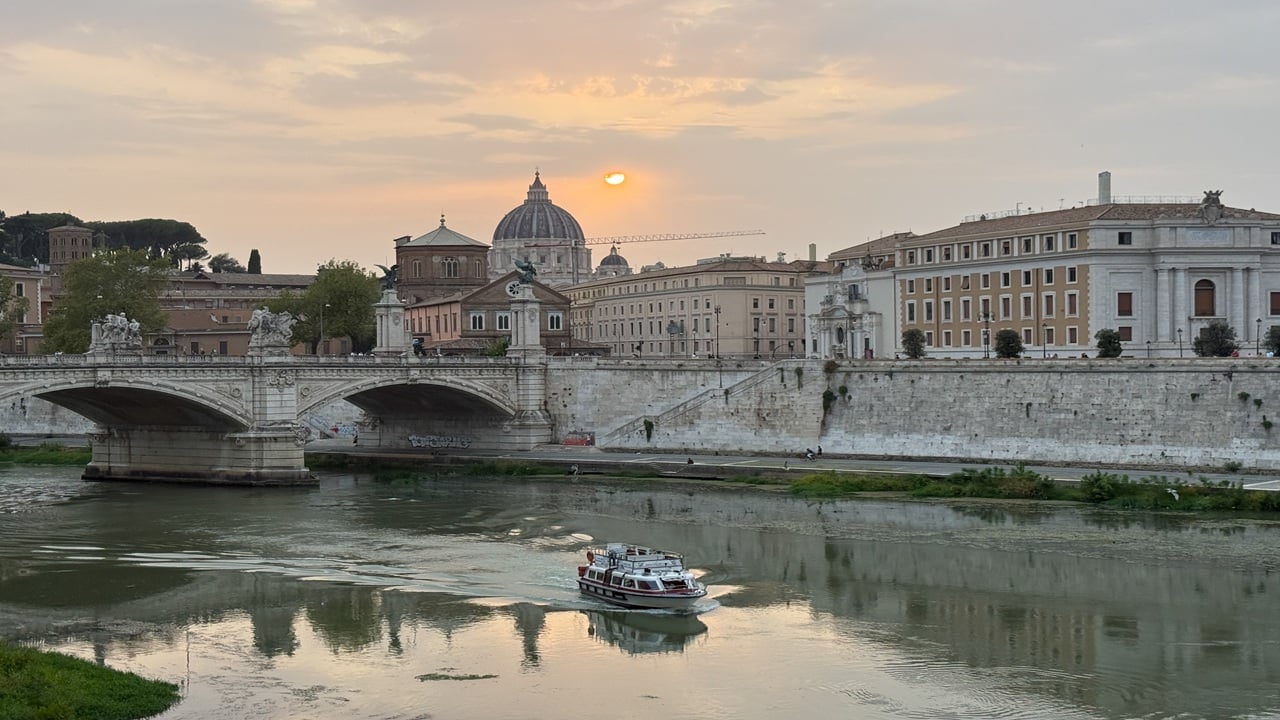
Castel Sant’Angelo has had quite the career. It was originally built as a mausoleum for Emperor Hadrian beginning around A.D. 135. Over the centuries, it was transformed into a fortress, papal residence and military structure. That history is part of what makes the building so interesting. It isn’t just one ancient monument frozen in time. You can see the different layers of Rome’s history stacked on top of each other.
To be honest, I didn’t tour the interior. We simply walked around the outside, and I think that’s a perfectly reasonable choice when you’re trying to see Rome in a limited amount of time. The exterior is impressive enough to justify the detour, particularly when you approach it from the bridge. Don’t skip Ponte Sant’Angelo, either. The bridge is lined with angel sculptures and gives you a beautiful view of the castle and the Tiber.
If you have more time and love history, the interior adds another substantial layer to the experience. If you’re tired by this point in the day, take your photos and keep going.
What to Know
- Time to Allow: 20–30 minutes outside; longer if touring the interior
- Admission: Free to view the exterior; paid admission for the museum
- Reservations: Recommended if visiting inside during busy periods (check ticket prices)
Continue to Stop #9: From Castel Sant’Angelo, continue toward Vatican City.
Walking Time: About 15 minutes to St. Peter’s Square
Distance: About 0.7 mile / 1.1 km


Stop #9: St. Peter’s Square
St. Peter’s Square is the final stop on this walking itinerary and a dramatic place to end the day. The enormous piazza sits directly in front of St. Peter’s Basilica and is surrounded by the sweeping colonnades designed by Gian Lorenzo Bernini. An ancient Egyptian obelisk stands at the center, with fountains on either side.
You don’t need a ticket just to experience the square, making it an easy place to finish even if you’re running low on time or energy. After walking through ancient Rome, Baroque Rome and the historic center, ending in Vatican City gives you a completely different perspective on the city. Take a few minutes to appreciate the scale of the space before deciding whether you want to continue into the basilica or explore more of Vatican City.
**I’ve also experienced St. Peter’s Square as part of the Papal Audience where the pope addressed the crowd. That experience was very different from simply walking into the square to sightsee, but I highly recommend it.
What to Know
- Time to Allow: 20–30 minutes
- Admission: Free to enter the square
- Reservations: Not required simply to visit the square
Recommended Restaurants Along the Route
- Achille Al Pantheon di Habana — 4.8★
- Camillo a Piazza Navona — 4.8★
- Il Tagliere Toscano Navona — 4.7★
- La Leggera Pizzeria Restaurant— 4.9★
- La Nuova Piazzetta — 4.8★
- Pane e Salame — 4.8★ (my favorite place for lunch!)
- Piccolo Deroma — 4.9★
- Pinsitaly Trevi — 4.8★
- Pizzeria Romana Rione Ponte — 4.7★
- Rione XIV Bistrot — 4.8★
- Ristorante Trattoria Antonio al Pantheon — 4.7★
- Tonnarello Pantheon — 4.8★
- Trattoria Della Stampa — 4.7★
Tips for Walking Rome
- Start early. This is probably my biggest piece of advice. Rome can be dramatically quieter before 8 a.m., and you also get a head start before the heat builds.
- Wear real walking shoes. This isn’t the day for cute shoes that you’ve only worn around the hotel. Rome’s historic streets can be uneven, and you’ll be on your feet for hours.
- Don’t underestimate summer heat. My latest August visit reached 101°F, and that changed how we approached the archaeological sites. You do not get bonus points for suffering.
- Book the major attractions ahead. The Colosseum requires a timed entry reservation, and the Vatican Museums use timed admission. If either is important to you, plan ahead rather than hoping you’ll figure it out when you arrive.
- Take breaks. The route is designed to connect the sights, not force you to sprint between them. Stop for coffee, gelato, lunch or a drink when you need one.
- Know when to skip something. This is especially important on a short visit. You can’t see everything in Rome, and you don’t need to. I’d rather skip an attraction than spend the entire day watching the clock.
Traveling Soon? Use my Favorite Resources for Booking Your Trip!
Book Your Flight
Expedia is my favorite flight search engine, because it checks dozens of airlines so you can easily find the best fare deals. You can also select ‘Watch Prices’ to get an email alert when the prices change.
Book Your Accommodations
I use both Booking.com and Expedia for hotels, because each offers a couple different hotel choices and I like to compare the reviews on each one. If you have a group or are looking for more of a home atmosphere, head over to VRBO or AirBNB that has houses, apartments and even just a room for rent in every price range.
Book Your Rental Car
If love the freedom to explore like I do, driving from place to place is the best option! I always book with RentalCars.com (it’s part of booking.com) for the best prices and top brand options.
Book Some Fun Tours!
Viator and Get Your Guide are my go-to search engines for cool bucket list experiences! Each one can have different tours, so check both—why limit yourself, right?
Don’t Forget Travel Insurance
Travel can be unpredictable. Whether it’s a last-minute cancellation, an injury, or (ugh) theft, things happen. That’s why I recommend never leaving the country without travel insurance. Here are my faves: Safety Wing and World Nomads.
Get Packing & Travel Essentials Ready
Check out the Bucket List Journey Amazon Store to find all my favorite travel essentials. Everything from Packing cubes, to travel adapters and toiletry containers to walking shoes.
Flying International?
Get Cell Data Before You Arrive: I recommend using airalo for international travel. Also, book an airport transfer in advance (I use Kiwi Taxi). Lastly, check travel.state.gov for visa requirements and safety information.
Save this Post to Pinterest